
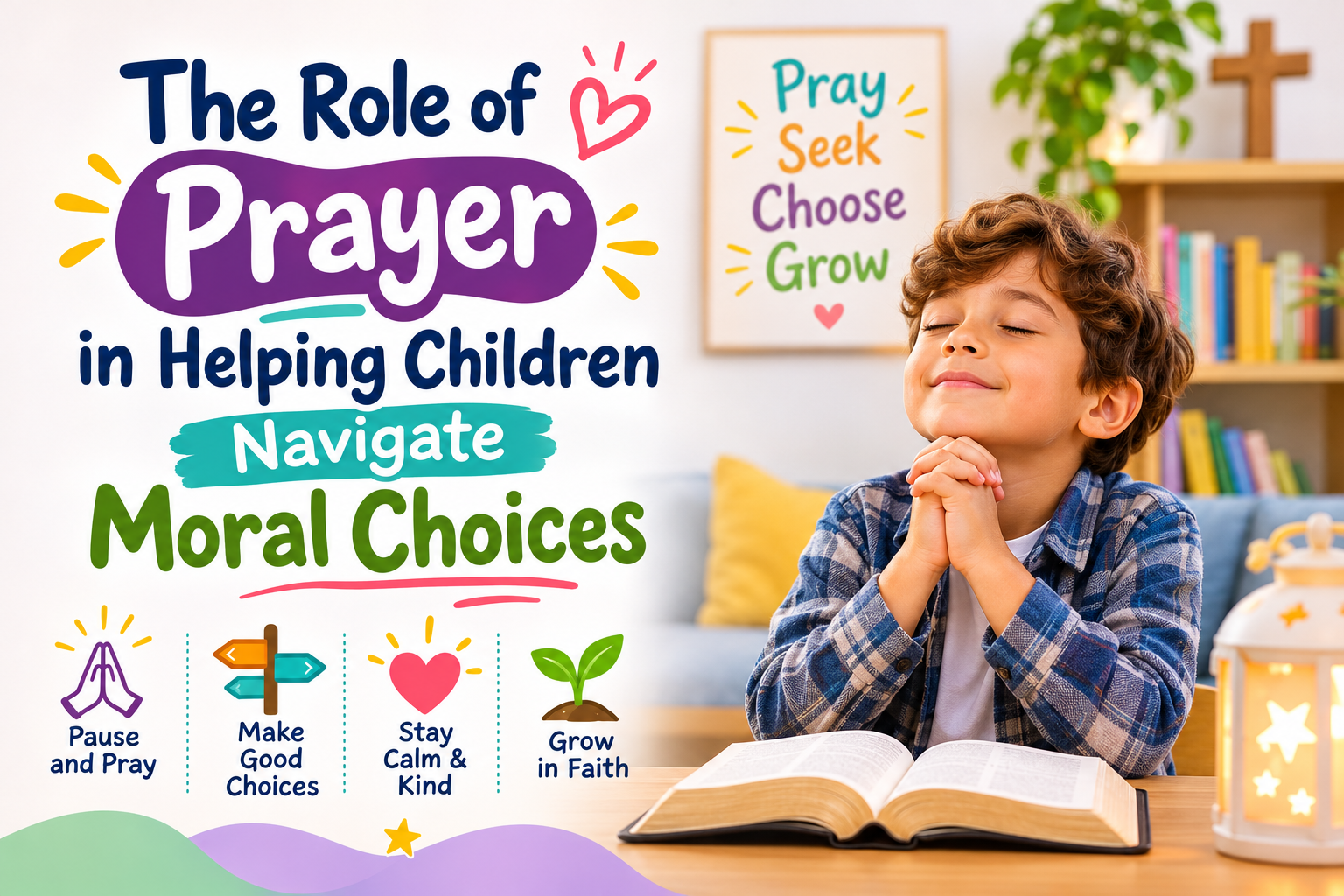
Prayer for kids is often introduced as a bedtime ritual or a tradition before meals. Children fold their hands, close their eyes, and recite familiar words before drifting off to sleep. These moments are beautiful and valuable, but they represent only a fraction of what prayer can offer a developing child.
When taught thoughtfully, prayer becomes a practical tool for navigating the moral challenges children face every day. This article examines how prayer supports moral decision-making in children aged four to ten and offers practical guidance for parents who want to deepen their child’s prayer life beyond rote repetition.
Prayer as a Pause Button
One of the most significant challenges in childhood moral development is impulsivity. Young children act on desire before they have time to consider consequences. They grab the toy, eat the cake, or tell the lie before their reasoning has a chance to intervene.
Prayer introduces a critical pause into this sequence. When a child has been taught to turn to God in moments of temptation, even a brief internal prayer creates a gap between impulse and action. That gap is where moral choice becomes possible.
This concept is illustrated clearly in Christian children’s books with prayer woven into the narrative. When a character pauses to pray before deciding whether to keep a found object or return it, young readers see a concrete example of how prayer functions in real time.
Moving Beyond Rote Prayer
Rote prayers serve an important developmental purpose. They introduce children to the rhythm and vocabulary of faith, and they create comforting routines that anchor a child’s spiritual life.
However, if prayer never evolves beyond memorized phrases, children may begin to view it as a performance rather than a conversation. Helping kids make good choices through prayer requires teaching them that prayer can be spontaneous, personal, and honest.
Parents can encourage this shift by modeling spontaneous prayer in everyday life. A brief prayer of gratitude during a car ride or a quick request for patience during a stressful morning shows children that prayer is woven into daily experience.
Three Types of Prayer Children Need
Child development researchers and faith-based educators often identify three categories of prayer that are especially relevant for young children. Each serves a distinct emotional and moral function in a child’s daily life.
The first is a prayer for strength before a challenge. This prepares a child for situations where the right choice will be difficult. Asking God for courage to tell the truth gives children a sense of support before the moment of decision arrives.
The second and third types address the moment of struggle and the aftermath. A prayer for help during temptation gives children an immediate lifeline when they are wrestling with a wrong desire, while a prayer of gratitude after the hard choice reinforces the victory and connects it to God’s presence and support.
How Prayer Supports Emotional Regulation
The benefits of teaching children to pray extend beyond moral decision-making into the broader domain of emotional regulation. Young children frequently experience emotions that overwhelm their capacity to cope.
Anger, jealousy, fear, and guilt can feel enormous and unmanageable to a five-year-old. Prayer gives children a structured way to externalize these feelings. Instead of bottling up frustration or acting out, a child who prays learns to name their emotions and direct them toward a compassionate listener.
This practice builds emotional intelligence alongside spiritual maturity. Children learn that struggling with difficult emotions is not a sign of weakness. It is a normal part of being human, and God is present in the middle of that struggle.
Practical Ways to Introduce Prayer
Start by keeping prayers short and specific. Long, abstract prayers lose a young child’s attention quickly. A simple “God, help me be kind to my sister today” is far more effective than a lengthy recitation of general blessings.
Use visual and tactile aids to make prayer concrete. A small prayer stone, a candle, or a designated prayer corner in the home can help children associate prayer with a physical space and a sensory experience.
Effective strategies for building a daily prayer habit include:
- Set a consistent time each day for family prayer, even if it lasts only one minute
- Encourage children to use their own words rather than repeating memorized phrases
- Read books that feature characters praying in moments of challenge
- Create a simple prayer journal where children can draw or write their requests
Prayer and the Power of Story
Faith-based storytelling is one of the most effective ways to introduce prayer as a living practice. When children read about characters who pray before difficult choices, they absorb the habit naturally and without resistance.
Books like The Adventures of Jo and Tula model all three types of prayer within a single story. Characters pray for strength, pray for help in moments of temptation, and pray in gratitude after making the right choice.
This narrative approach makes prayer feel accessible and relevant to young readers. It moves prayer from the margins of daily life into the center of moral decision-making.
Building a Lifelong Practice
The prayer habits children develop between the ages of four and ten often persist well into adolescence and adulthood. Parents who invest time in teaching children to pray with sincerity and spontaneity are giving them a resource that will serve them for a lifetime.
Prayer is not a magic formula that eliminates moral struggle. It is a relationship that gives children the courage, clarity, and comfort they need to navigate that struggle with grace.
When prayer becomes a natural part of a child’s daily life, good choices become not just possible but deeply personal. The foundation laid in these early years will support a lifetime of faith, integrity, and moral courage.
